

Regulatory resilience design and implementation on Salesforce Financial Services Cloud

Why DORA requires more than policy alignment
The Digital Operational Resilience Act (DORA) introduces explicit expectations around operational resilience, auditability, and accountability for financial entities.
While many organisations focus on policy updates and documentation, supervisory reviews increasingly test how controls are implemented, evidenced, and operated in practice.
Salesforce Financial Services Cloud (FSC) is often part of the operational landscape supporting these processes. Aligning FSC capabilities with DORA expectations requires deliberate architectural choices — not just configuration.
Our focus
We support financial services organisations in designing and implementing DORA-aligned operating models on Salesforce Financial Services Cloud, with particular attention to:
- Evidence generation and retention
- Decision traceability across systems and processes
- Platform-level security, monitoring, and audit controls
- Integration with external compliance, reporting, and assurance functions
- Clear mapping between regulatory requirements and operational practices
Our work sits at the intersection of regulatory interpretation, platform architecture, and operational execution.
Tri-Layer regulatory architecture
Our advisory approach is based on a tri-layer model:
- Regulatory layer — interpretation of DORA requirements and supervisory expectations
- Operational layer — processes, controls, and accountability structures
- Platform layer — implementation on Salesforce Financial Services Cloud and connected systems
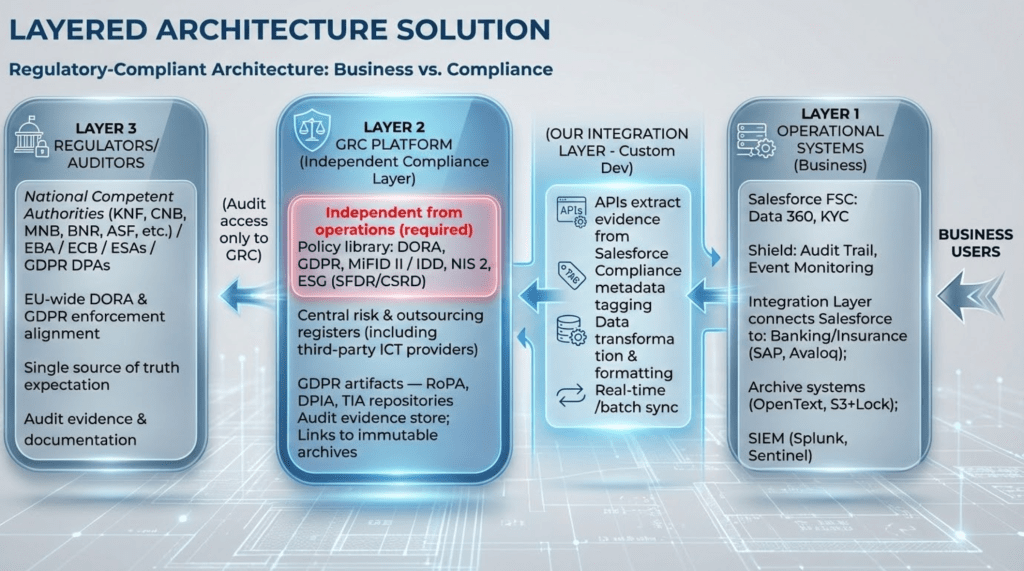
This structure helps ensure that regulatory intent is preserved as it moves from interpretation into day-to-day operation.
In environments where Salesforce Financial Services Cloud is part of the core operational stack, these considerations directly influence auditability, accountability, and supervisory confidence.
Validating readiness
Before initiating remediation or implementation work, it is often useful to establish a clear baseline of current alignment.
We provide an independent DORA readiness diagnostic that evaluates a small set of high-impact domains commonly examined during audits and supervisory reviews.
The diagnostic is deterministic, transparent, and designed to support informed decision-making — not to replace formal assessments.
The scorecard highlights where platform design choices may support — or undermine — DORA expectations in practice.
Validate current alignment across key DORA domains
Engagement approach
Use of the readiness scorecard does not initiate automated outreach.
Follow-up discussions are contextual and typically occur where there is a clear regulatory, architectural, or operational question to address.
Further discussion
Where appropriate, findings from the diagnostic can be discussed in the context of supervisory expectations, audit preparation, or platform design decisions.
 IS-Consulting | Salesforce Architecture & Integration